
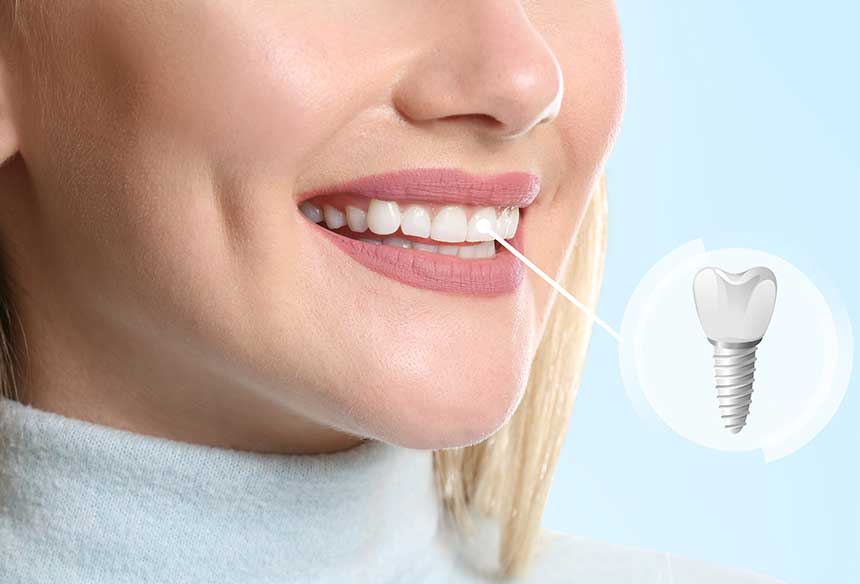
Missing teeth can make it harder to eat, speak, and feel confident about your smile. Dental implants offer a durable tooth replacement option that is designed to look, feel, and function more like natural teeth.
At Cheyenne Mountain Dental Care, our dentist in Colorado Springs can evaluate your oral health and discuss whether dental implants may be right for you. Whether you’re missing one tooth, several teeth, or need a more comprehensive tooth replacement solution, we can help you understand your options.
If you’re considering dental implants in Colorado Springs, call our dental team in Colorado Springs at (719) 576-1730. We also proudly serve patients coming from Manitou Springs, Fountain, Monument, and surrounding communities.
Dental implants are tooth replacement devices designed to replace the roots of missing teeth. A dental implant is placed into the jawbone and allowed to integrate with the surrounding bone. Once healing is complete, the implant can support a dental restoration such as a crown, bridge, or denture.
Unlike traditional bridges, dental implants don’t require support from neighboring teeth. They can provide a stable foundation for replacement teeth and help restore normal chewing and speaking.
A typical dental implant restoration has three main components:
Dental implants can offer several advantages for patients with missing teeth.
Potential benefits include:
Dental implants aren’t appropriate for every patient, so an evaluation is important before treatment begins.
Many adults with missing teeth may be candidates for dental implants. However, candidacy depends on your oral health, general health, jawbone, and treatment goals.
You may be a candidate if you:
Certain health conditions, medications, smoking, or insufficient bone volume may affect implant treatment. Your dentist will review your medical and dental history before recommending a treatment plan.
Dental implant treatment typically takes place over several stages. The exact process and timeline vary depending on how many teeth you’re replacing and whether additional procedures are necessary.
Your Colorado Springs dentist will begin by evaluating your teeth, gums, and jawbone. Dental X-rays or other imaging may be used to assess bone structure and determine the best location for implant placement.
We’ll discuss your goals and explain your available tooth replacement options. If you’re a candidate for implants, we’ll develop a personalized treatment plan.
If a damaged or non-restorable tooth needs to be removed, extraction may be necessary before implant placement. In some situations, an implant can be placed at the same appointment as an extraction, depending on the condition of the tooth and surrounding bone.
If your jawbone isn’t adequate to support an implant, a bone graft or another preparatory procedure may be recommended.
During implant surgery, the implant is placed into the jawbone. Local anesthesia and other comfort options may be available depending on the procedure and your needs.
The implant serves as an artificial tooth root and provides the foundation for your replacement tooth.
After placement, the implant needs time to heal and integrate with the surrounding jawbone. This process, known as osseointegration, helps create a stable foundation for the final restoration.
The healing period varies from patient to patient.
Once the implant has sufficiently healed, an abutment can be placed to connect the implant to the replacement tooth.
Your final restoration may be a dental crown, implant-supported bridge, or implant-supported denture, depending on the number of teeth being replaced.
A single dental implant can replace one missing tooth without relying on neighboring teeth for support.
A dental implant and crown can provide a natural-looking replacement while allowing you to maintain your remaining natural teeth.
Your dentist will evaluate the missing tooth’s location, available bone, gum health, and bite when planning treatment.
If you’re missing several teeth, implants can support a bridge or another restoration designed to replace multiple teeth.
An implant-supported bridge can replace several adjacent missing teeth without requiring a separate implant for every tooth being replaced.
The number of implants needed depends on your anatomy, the location of the missing teeth, and the restoration selected.
Patients who have lost most or all of their teeth may be candidates for implant-supported dentures.
Unlike conventional dentures, which rest on the gums and can move during eating or speaking, implant-supported dentures are anchored to dental implants for additional stability.
Implant-supported dentures may make eating and speaking more comfortable while providing a more secure alternative to traditional removable dentures.
Not everyone needs a bone graft. However, tooth loss can gradually reduce jawbone volume. If there isn’t enough bone to securely support an implant, bone grafting may be recommended.
A bone graft adds material where more bone volume is needed. After the graft heals, implant placement may be possible.
Your dentist can determine whether bone grafting is necessary using an examination and appropriate imaging.
Dental implants are designed to be a long-term tooth replacement solution, but their longevity depends on several factors.
Good oral hygiene, regular dental visits, healthy gums, avoiding tobacco, and following your dentist’s recommendations can help protect your implants.
The implant itself may remain functional for many years, while the crown, bridge, or denture attached to the implant may eventually need repair or replacement due to normal wear.
The cost of dental implants varies from patient to patient. Factors that can affect the total cost include:
Because every implant case is different, a consultation is the best way to receive an individualized estimate.
Some dental insurance plans may provide benefits toward portions of implant treatment. Ask our team about your estimated costs, insurance coverage, and available payment options before beginning treatment.
Dental implants aren’t the only way to replace missing teeth. Depending on your needs, you may also be a candidate for a traditional dental bridge or removable dentures.
Your dentist can compare these options with you and recommend an approach based on your oral health, goals, and budget.
Taking care of dental implants is similar in many ways to caring for natural teeth.
To protect your oral health:
Although implants aren’t susceptible to cavities like natural teeth, the surrounding gums and bone still need proper care.

The implant placement procedure is performed using anesthesia to keep you comfortable. Some soreness, swelling, or tenderness may occur afterward. Your dental team will provide instructions for managing your recovery.
The overall process can take several months because the implant needs time to heal and integrate with the jawbone before the final restoration is placed. Your timeline may be shorter or longer depending on your individual treatment plan.
Yes. Depending on your needs, multiple implants can support an implant-supported bridge or denture. You don’t necessarily need one implant for every missing tooth.
Possibly. Patients with insufficient bone may be candidates for bone grafting or other procedures before implant placement. Your dentist will evaluate your jawbone to determine what is possible.
Dental implants and dentures have different advantages. Implants provide a fixed foundation and can offer greater stability, while conventional dentures are removable and may be a more affordable option for some patients. Your dentist can help you compare the choices.
The best way to determine whether you’re a candidate is to schedule an examination. Your dentist can evaluate your teeth, gums, jawbone, overall health, and treatment goals before recommending an option.
Missing teeth don’t have to affect the way you eat, speak, or feel about your smile. Dental implants can provide a stable, natural-looking foundation for replacing one tooth, several teeth, or an entire arch.
If you need to schedule a dental appointment in Colorado Springs, call Cheyenne Mountain Dental Care at (719) 576-1730. We proudly serve patients throughout Colorado Springs, Manitou Springs, Fountain, Monument, and surrounding communities. Our team can evaluate your needs, explain your treatment options, and help you determine the next step toward restoring your smile.